Building Better: Why Passivhaus Makes Sense for Self Builders and Renovators
With rising energy costs and a growing focus on comfort and sustainability, Passivhaus is becoming a practical solution for homeowners looking to build or renovate more efficiently.
With energy costs rising, and growing awareness of how our homes affect both comfort and health, Passivhaus is no longer seen as a niche aspiration. Increasingly, it is becoming a practical route for homeowners who want to build or renovate better-performing homes.
Whether applied to a new build or a major renovation, the Passivhaus approach focuses on one thing above all: how a building actually performs.
Passivhaus is an internationally recognised building standard designed to deliver exceptional comfort, excellent indoor air quality and extremely low energy use. Backed by more than 30 years of measured performance, it is widely regarded as one of the most effective low-energy building standards in the world.
For many self-builders and renovators, improving energy efficiency may start as a goal - but it often becomes the guiding principle for the whole project.
The standard can be applied to almost any type of home. And when upgrading an existing building, the EnerPHit standard adapts Passivhaus principles to suit older properties, helping them achieve similar levels of performance wherever possible.
Given that we spend most of our lives indoors, the performance of our homes has a direct impact on our comfort, health and long-term running costs.
Designing for Performance from the Start
The most successful Passivhaus projects begin early in the design process.
When the principles are considered from the outset, the building’s design, materials and systems can work together more effectively. Good insulation, airtight construction, high-performance windows and carefully designed ventilation all play a role in creating a home that is comfortable and efficient.
If these elements are introduced late in a project, they can become harder - and sometimes more expensive - to deliver. But when they are integrated from the beginning, they can guide smarter design decisions without increasing overall costs.
This early, performance-led approach is one of the key reasons Passivhaus buildings consistently achieve such strong results.
Five Reasons to Consider Passivhaus
- Comfort all year round - Stable indoor temperatures, even during extreme weather.
- Healthier indoor air - Continuous filtered fresh air improves air quality and wellbeing.
- Very low heating demand - Homes can require up to 90% less energy for heating than conventional buildings.
- Quality assurance - Detailed design, modelling and testing help ensure the finished building performs as intended.
- Future-ready homes - Lower energy use helps protect against rising costs and tightening regulations.
Passivhaus is far from experimental. Thousands of buildings around the world have been built and certified to the standard, proving that ultra-low energy use and exceptional comfort can go hand in hand.
In the UK, the development and promotion of the standard is supported by the independent, non-profit Passivhaus Trust, which works to advance high-performance building and support the transition to net-zero homes.
Making Building Science Easier to Understand
For many homeowners, the challenge isn’t deciding they want a better performing home - it’s understanding how to achieve one.
That’s where The National Self Build & Renovation Centre (NSBRC) plays an important role.
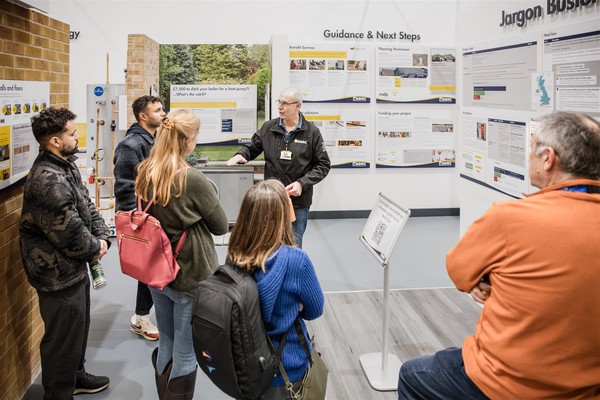
Open six days a week (Tuesday to Sunday) and free to visit, the centre provides a hands-on learning environment where building science becomes easier to understand. Full-scale exhibits and interactive displays show visitors how insulation works in practice, how airtight construction is achieved and how modern ventilation systems operate.
Instead of relying solely on theory, visitors can explore real construction details and speak directly with technical specialists.
For those looking to go further, the centre also hosts a dedicated Passivhaus Workshop, delivered in partnership with the Passivhaus Trust.
Inside the Passivhaus Workshop
Designed specifically for self-builders and renovators, the workshop combines expert guidance with practical insight into building a high-performance home.
The programme typically includes:
- An introduction to the key principles behind Passivhaus
- Technical sessions covering insulation, airtightness, ventilation, windows and doors
- Real-world case studies from completed projects
- Question-and-answer sessions with industry specialists
- Advice on upgrading existing homes through deep retrofit
Whether you are still shaping early ideas or refining specifications, the workshop helps clarify what good building performance looks like - and how to achieve it.
Visitors often highlight the value of seeing real construction details in context:
“If you’re planning any sort of self build or renovation, this is the place to go.” — NSBRC Visitor
“I learnt a lot from the speakers and from the displays in the building. Definitely will visit again.” — Workshop Attendee
Real Projects, Real Results
Real homes demonstrate how thoughtful design decisions can dramatically improve building performance.
Case studies from NSBRC visitors show how Passivhaus principles have been applied to both new builds and renovation projects - often delivering remarkable improvements in comfort and energy efficiency.
In Oxford, Guy and Susan Hargreaves transformed their 1906 mid-terrace home through a major renovation and extension, achieving EnerPHit certification while retaining the building’s character.
Meanwhile in Weymouth, Dorset, Alan Muncaster carried out a full retrofit of his detached bungalow. By improving insulation and installing mechanical ventilation with heat recovery, solar panels, battery storage and an air source heat pump, the home’s EPC rating was improved from D to A.
Stories like these demonstrate that Passivhaus thinking isn’t limited to new builds - existing homes can also be transformed into comfortable, low-energy spaces.
Find Out More
Free tickets link – click here to book your place now.