





In case you missed it see what’s in this section
Let's Talk
Your Total Guide To lifestyle

The Total Guide To full fibre broad band in rural areas: Bringing modern connectivity home
For a long time, moving to the countryside came with an unwritten rule: you trade the bustle of the city for slower internet. It was an annoyance people simply accepted as the price of aview. But as the world moved online, that compromise stopped being a minor quirk and started becoming a genuine barrier.
Living in a rural village shouldn't mean dropping out of a work call because someone else started streaming in the next room. High-speed connectivity is no longer a luxury; it is the backbone of how we work, learn, and stay healthy. In counties like Dorset, where communities have historically been left behind by big providers, full fibre is finally closing that gap. It is about making sure that choosing a rural lifestyle doesn't mean being disconnected from a modern one.
Why rural broadband has lagged behind

To understand why full fibre matters so much, it helps to look at why rural areas have historically struggled with connectivity. Much of the UK’s early broadband infrastructure evolved from copper telephone lines. These lines were originally designed for voice calls, but not for high-speed data. When internet access became widespread, the same copper network was adapted to carry digital signals.
This method often worked "well enough" in towns and cities, where homes are close together and near exchanges or street cabinets. But in rural areas, homes can be hundreds of meters, and sometimes even miles, away from the nearest connection point. The signal gets weaker and slower the longer it has to travel over copper. That's why so many people who live in the country have had problems with slow speeds and bad performance, especially during busy times.
Over time, partial fibre solutions were introduced. Fibre cables would run to a cabinet, but the final stretch to the home still relied on copper. While this improved speeds for some, it didn’t eliminate the fundamental issue. Rural communities were still relying on ageing infrastructure that simply wasn’t built for modern demand.
What makes full fibre different
Full fibre broadband, often referred to as fibre-to-the-premises (FTTP), replaces copper entirely. Instead of data travelling as electrical signals through metal wires, it moves as pulses of light through fibre optic cables. These cables run directly from the network to your home, delivering far greater consistency and performance.
The shift to fibre is not theoretical, it is already well underway. According to Ofcom, 69% of UK homes (around 20.7 million properties) now have access to full-fibre broadband. That figure has risen sharply from 57% just a year earlier, demonstrating how quickly the infrastructure is expanding. Northern Ireland currently leads the rollout, with 93% of homes able to access full fibre.
In counties like Dorset, where homes are often spread across market towns, villages, and rural hamlets, this expansion is particularly significant as more properties gain access to infrastructure that was previously concentrated in larger urban areas. With the Government targeting 85% nationwide coverage by 2025, it’s clear that gigabit connectivity is becoming the standard rather than the exception. For rural communities, this progress matters. It signals a decisive move away from patchwork upgrades towards long-term, future-proof infrastructure.
What full fibre broadband installation involves
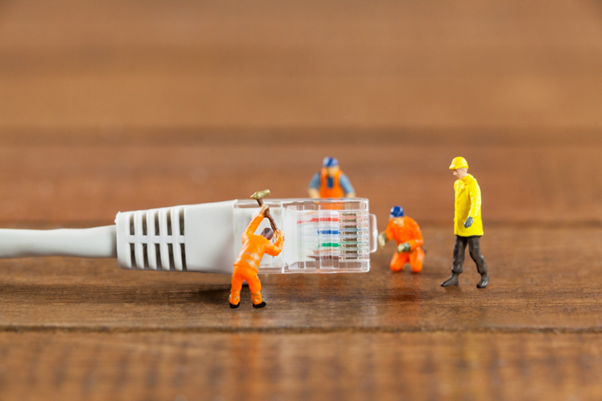
Many homeowners have practical worries about the idea of installation. Will it mean digging up the driveway? Will the garden be messed up? How long will it take?
In reality, installing full fibre broadband is usually easier than people think. The first step is to do a survey to find the best way to get from the current fibre network to your property. This planning stage is especially important in rural areas because it makes sure that work is done quickly and with as little effect on the surrounding landscape as possible.
Depending on the location, fibre cables may be installed underground using narrow trenching techniques, threaded through existing ducts, or delivered via overhead poles. Once the cable reaches your property, a small external connection box is fitted discreetly to an outside wall.
Inside the home, an engineer installs the necessary equipment and connects the router in your chosen location. The system is then tested to confirm that speeds and stability meet expectations. While every property is different, the in-home portion of the installation is typically completed within a few hours. For rural homeowners who have spent years coping with unreliable connections, the change can feel immediate and dramatic.
How it transforms everyday life
The true impact of full fibre broadband is felt in the rhythm of daily life. It’s in the absence of frustration and the presence of confidence. Remote working has become a permanent feature for many people.
Whether you’re running a business from a converted barn or logging into meetings from the kitchen table, stable connectivity is essential. Full fibre supports high-quality video calls, fast uploads, and seamless access to cloud-based systems. It removes the anxiety of wondering whether the connection will hold up during an important presentation.
Family life is also better. The network won't slow down if more than one person is streaming movies, taking online classes, playing games, or browsing the web at the same time. Evening routines go more smoothly. Whoever logs off first doesn't have to worry about weekend fun.
Smart home tech also becomes useful in real life. These systems need constant internet access for things like smart heating controls, security cameras, voice assistants, and connected appliances. A strong underlying connection is what makes smart technology work in many rural homes, especially older homes with thick walls.
There is also a property dimension to consider. Increasingly, buyers ask about broadband speeds before arranging viewings. A home with full fibre installed signals readiness for modern living. It shows that the property is equipped not just for today’s needs but for whatever comes next.
The wider impact on rural communities
Better broadband in rural areas helps more than just individual homes; it also helps communities as a whole. In places like rural Dorset, where many residents live in small villages or countryside properties outside larger towns such as Blandford Forum, Buckland Newton, or Wool, reliable connectivity can make a significant difference to how people work, run businesses, and stay connected to essential services. Reliable internet access helps local businesses run smoothly and reach more customers. It gives business owners the confidence to move to rural areas, knowing that infrastructure won't be a problem.
Schools and students benefit from having regular access to online learning tools and resources. More and more healthcare services are being provided through online consultations and remote monitoring tools that need stable internet connections. This can really improve quality of life in places that are more remote.
Community groups and local councils can communicate more effectively through digital channels, keeping residents informed and connected. Over time, better connectivity contributes to economic resilience and social cohesion, ensuring that rural areas remain vibrant places to live and work.
Making connectivity work throughout the home

Bringing fibre to the front door is only one part of the picture. A lot of rural homes are bigger or made of materials that can make Wi-Fi signals weaker. Even with a fast external connection, thick stone walls and long layouts can make dead spots that are hard to get to.
That's why it's important to think about more than just the installation and coverage for the whole house. Internet providers, such as Wessex Internet's offering Total Wi-Fi and other services are made to work with full fibre broadband installation by providing reliable coverage throughout the property. Homeowners can make sure that every room, from the home office to the garden, has strong performance by using high-speed fibre and smartly placed Wi-Fi equipment. When the outside connection and the inside network are in sync, you get a smooth experience that really helps people live in the country today.
A future without compromise
Installing full-fibre broadband is a big step forward for rural broadband because it closes the gap between homes in cities and homes in the country. It lets people build careers without having to move. It lets families have fun and learn without getting upset. It helps businesses and makes communities stronger. It brings back the most important thing, which is the choice. People who live in rural areas don't have to settle for second best when it comes to digital infrastructure anymore.
As fibre networks grow, people living in rural counties like Dorset can look forward to a future where where they live enhances their quality of life rather than limiting it. With the right infrastructure, living in the country and having high-speed internet can go hand in hand. It's not a compromise; it's a powerful combination.











Weather in Dorset
Listings