






In case you missed it see what’s in this section
Let's Talk
Your Total Guide To lifestyle

Coastal Boating in Dorset: Helm and Honda Outboard Control Checks Before You Leave the Harbour
A run across Poole Bay, a fishing trip from Weymouth, or a day exploring the Jurassic Coast can begin in calm water and quickly move into busier, more exposed conditions. Before casting off, take a few minutes to check the controls that let you start, stop, shift, and adjust the outboard. The best place to find a helm problem is alongside the dock – not while maneuvering through a crowded harbour entrance.
How to Check Honda Outboard Controls Before a Coastal Trip
First, identify the complete setup: Honda outboard model, horsepower, control type, number of engines, and number of operating stations. Side-mount, top-mount, single-engine, multi-engine, and dual-station systems do not necessarily use interchangeable parts. Browse Honda outboard controls only after recording the existing part number, connector arrangement, and helm configuration.
A quick test is easier when each symptom has a clear follow-up:
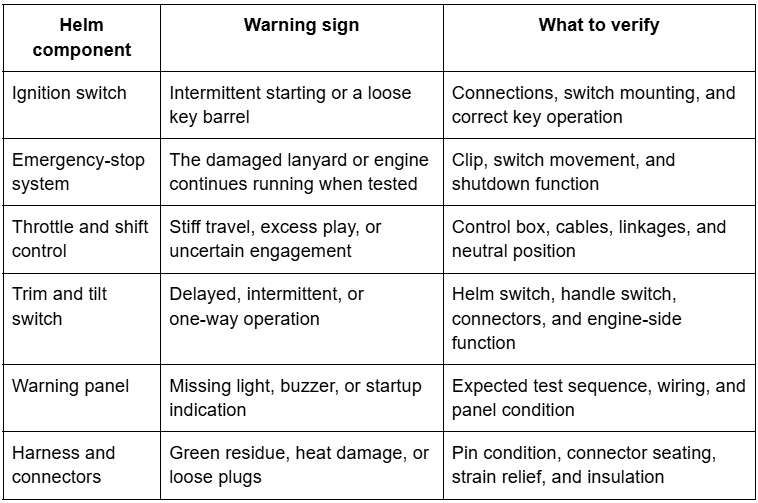
Prepare the boat safely before moving any controls. Keep the boat secured, make sure the propeller area is clear, and follow the owner’s manual for the specific test. Do not repeatedly force a stiff lever; resistance can come from the control box, cable, linkage, or engine-side mechanism, and extra pressure may worsen the damage.
Use a simple three-part routine:
- Start and stop: Test the key switch, neutral-start protection, emergency-stop lanyard, and shutdown operation.
- Move and adjust: Check throttle and shift travel, then operate trim and tilt from each fitted control location.
- Inspect and listen: Confirm normal indicators and alarms while looking for cracked housings, loose fasteners, moisture, salt deposits, or damaged wiring.
Any uncertainty about a warning light or buzzer should be resolved through the correct Honda manual. Indicator behavior differs among engine families, so a light that appears normal on one installation may signal a problem on another.
Why the Helm Deserves a Pre-Departure Check
The helm is where the operator’s decisions become engine commands. The ignition circuit starts and stops the outboard, the control lever manages gear and throttle input, and trim switches change the engine angle. Warning indicators provide information that may require an immediate response. None of these parts is merely decorative dashboard hardware.
That matters around Dorset’s coastal launch points. Leaving Poole or Weymouth can involve close-quarter maneuvering near moored boats, harbour traffic, paddlers, personal watercraft, and commercial vessels. Smooth, predictable control response is especially valuable when there is limited room to correct a delayed shift or inconsistent throttle input.
Coastal exposure also works quietly. Salt spray settles around switch openings and connectors; ultraviolet light makes plastic housings and lanyards brittle; vibration loosens hardware; and moisture can reach electrical contacts.
A control may continue to work while secured at the marina, yet behave intermittently once the boat starts moving.
Helm Components Worth Checking Before Departure
Think of the helm as three connected groups rather than a collection of unrelated switches:
- Safety functions: ignition, emergency stop, lanyard, and neutral-start protection
- Boat response: throttle, shift, control cables, and trim or tilt switches
- Operator information: warning lamps, buzzers, gauges, harnesses, and electrical connectors
This grouping helps with diagnosis. If the trim switch at the engine works but the helm switch does not, for example, the fault may be closer to the helm circuit. If the lever itself is stiff, replacing an ignition panel would accomplish nothing.
Why a Five-Minute Helm Check Can Improve a Coastal Day
A short inspection fits naturally between checking the weather and removing the dock lines. It provides time to notice a split lanyard, a loose control box, or salt residue around a connector before the boat becomes harder to access.
The check also creates a useful baseline. If a lever suddenly feels heavier than it did on the previous outing, or an indicator behaves differently during startup, the change is easier to recognize. That early clue can turn an uncertain day on the water into a straightforward dockside inspection.
The helm check should sit within a broader departure routine. Dorset boaters still need to consider tides, weather, fuel, safety equipment, local notices, and planned vessel movements. Control-system readiness addresses one important part of the trip; it does not replace passage planning.
Why the Right Replacement Depends on the Existing Rigging
Not every helm fault calls for a complete control assembly. A worn lanyard, failed trim switch, loose mounting fastener, or damaged connector may be a focused repair. Internal control wear, extensive corrosion, or an outdated installation can require a larger job. Diagnosis should come before purchasing.
Visual similarity is a poor compatibility test. Two panels may have the same general shape while using different plugs, pin arrangements, warning-light layouts, or mounting dimensions. A replacement must suit:
- The exact engine family and horsepower
- Single- or multi-engine operation
- Side-mount, top-mount, or panel installation
- Single- or dual-station rigging
- Existing harness connectors and warning functions
Check the installed part number whenever it is readable, then confirm whether it has been superseded. Inspect the surrounding harness and mounting surface as well. Fitting a new panel to corroded terminals or damaged wiring is unlikely to solve the underlying problem.
Honda Outboard Helm and Control Checklist
Complete this sequence while the boat is still secured:
- Record the engine model, horsepower, and serial information.
- Identify the control style and number of engines and stations.
- Test ignition, neutral-start protection, and emergency shutdown.
- Check throttle and shift travel without forcing the lever.
- Operate every fitted trim and tilt switch.
- Confirm the expected startup lights and audible warnings.
- Inspect housings, plugs, harnesses, fasteners, and visible cable runs.
- Resolve stiffness, corrosion, loose parts, or intermittent operation before departure.
FAQ
Should the emergency-stop lanyard be attached during normal operation?
Follow the boat and engine manufacturer’s instructions. The lanyard is generally intended to be secured to the operator so the engine stops if the operator moves away from the helm unexpectedly.
What if trim works at the outboard but not from the control handle?
That difference can help narrow the search to the handle switch, helm wiring, or related connections. It does not prove that the entire control box needs replacement.
Is it safe to spray the helm with a pressure washer?
Direct high-pressure water can drive moisture into switch openings, seals, and connectors. Clean the helm using the methods recommended by the equipment manufacturer, and avoid flooding electrical components.
What should I do if the control lever becomes stiff after winter storage?
Do not try to free it with excessive force or unapproved lubricant. The cause could be inside the control box, along the cable run, or at the engine linkage. Isolate the source or have the system inspected before operating the boat.











Weather in Dorset
Listings