





In case you missed it see what’s in this section
Let's Talk
Your Total Guide To lifestyle
From Cash-in-Transit to Public Buildings: Where Ballistic-Resistant Materials Are Used Today
Ballistic protection is no longer confined to military vehicles or combat positions. It now appears in armored cash carriers, bank transaction areas, courthouses, police facilities, utility control rooms, guard booths, and selected areas of schools and government buildings. Often, the protective layer sits behind ordinary finishes so the space can remain functional rather than feel like a bunker. Walls, windows, doors, windshields, and enclosures can all form part of a modern bullet-resistant system.
At the material stage, armor plate suppliers provide steel for vehicle panels, barriers, and equipment shielding. Plate alone, however, does not determine performance. Frames, joints, fasteners, glazing, installation, and the selected test standard all affect the finished system.
Cash-in-Transit Protection Has to Work in Motion
A cash-in-transit vehicle is not simply a standard van with thicker bodywork. Its protective package must safeguard occupants and cargo without compromising handling, braking, visibility, payload, or emergency exit. Steel armor may be integrated into doors, body panels, bulkheads, and cargo enclosures, while transparent armor maintains necessary sightlines.
Added weight affects suspension, hinges, tires, braking components, and vehicle stability. Continuity matters too. Door frames, window interfaces, access openings, and transitions between opaque and transparent armor must form one protective envelope rather than a collection of strong individual panels.
Daily service adds wear that a static barrier does not experience. Doors open repeatedly, road vibration works on connections, and exterior components face water, salt, and temperature changes. Inspection access and replaceable hardware, therefore, need to be considered during the original build.
Public Buildings Protect Specific Zones
Buildings are larger, serve more people, and must preserve circulation, accessibility, fire safety, and normal public interaction. Rather than reinforcing every surface, designers generally concentrate protection where exposure and consequences are highest.
Depending on the facility and its risk assessment, protection may be added around reception or transaction counters, controlled doors and glazing, dispatch rooms, guard stations, utility control rooms, or designated protected spaces. Courthouses, police stations, government offices, schools, banks, and infrastructure facilities may use different combinations of opaque panels, transparent armor, reinforced frames, and protected openings.
The design still has to match the institution. A utility control room may prioritize operational continuity. A courthouse must also manage queues and staff circulation. In a school, any protective measure must coexist with supervision, emergency egress, and an environment that does not feel institutional. Copying one security package across all three would ignore how the spaces actually work.
The Material Is Only One Layer of the System
Ballistic protection may use steel, transparent armor, fiber-reinforced panels, polyethylene systems, ceramics, or several materials together. Selection depends on available space, weight limits, visibility, structural support, environmental exposure, and the defined threat.
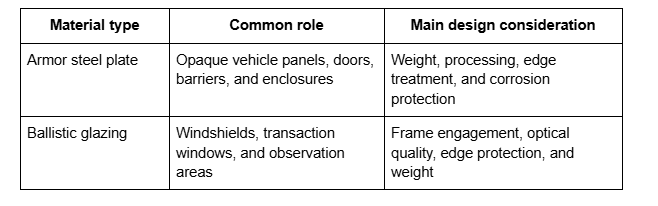
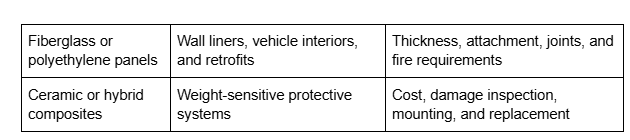
No option is universally better. Steel offers robust opaque protection, lighter panels help where supporting capacity is limited, and glazing preserves sightlines. Hybrid systems are common because a single material rarely satisfies every requirement.
The weakest detail can govern the result. An unprotected seam, inadequate frame, exposed fastener path, or poorly supported opening may compromise an otherwise tested panel. Barrier standards, therefore, address complete materials, devices, assemblies, and fixtures, including resistance to penetration, fragmentation, and spalling behind the protected surface.
Processing also requires control. Cutting, forming, drilling, and welding can alter edge condition, fit, residual stress, and local material behavior. A certified plate is an input to the system, not proof that the completed door, wall, or vehicle has achieved a particular rating.
Defense Standards Shaped Civilian Procurement Discipline
Civilian protective projects have adopted practices long associated with defense procurement: clear acceptance criteria, material traceability, controlled processing, repeatable testing, and documentation that follows the component through fabrication. Work involving military grade steel often places particular emphasis on consistent properties, dimensional preparation, and process records.
The label itself is not a complete specification. A useful requirement identifies the grade and thickness, defined threat, test method, acceptable deformation or fragmentation, environmental conditions, and processing restrictions. “Ballistic-resistant” is more accurate than “bulletproof” because performance is established against stated test conditions, not every possible projectile.
Standards must also match the product. NIJ Standard 0101.07 applies to torso-worn ballistic body armor for U.S. law enforcement, and NIJ states that its certification program does not cover products such as backpacks, blankets, or briefcases. Fixed barriers, glazing, doors, and enclosures should be evaluated under standards written for those assemblies.
The defense influence is therefore procedural rather than interchangeable. A courthouse counter, armored vehicle door, and patrol vest solve different problems and should not be specified under one generic rating.
Questions to Resolve Before Ordering
What is the defined threat? Identify the applicable standard, test conditions, and required coverage.
How will the complete assembly close its gaps? Review frames, overlaps, glazing interfaces, doors, penetrations, fasteners, and support.
What else must the system do? Account for vehicle weight, visibility, corrosion, fire performance, accessibility, maintenance, egress, and appearance.
These decisions belong with qualified security professionals, engineers, testing specialists, and the project authority. Suppliers and fabricators can support material verification, traceability, processing, and dimensional control, but they should not define the threat on the owner’s behalf.
Protection Is Becoming More Practical
Modern protective design is less about making every space look fortified and more about placing tested resistance where it serves a clear purpose. The material matters, but the complete system matters more: a realistic threat assessment, the correct standard, compatible components, controlled fabrication, and careful installation.
When those pieces align, ballistic protection can improve safety in vehicles and public buildings without dominating how they look or function.











Weather in Dorset
Listings